
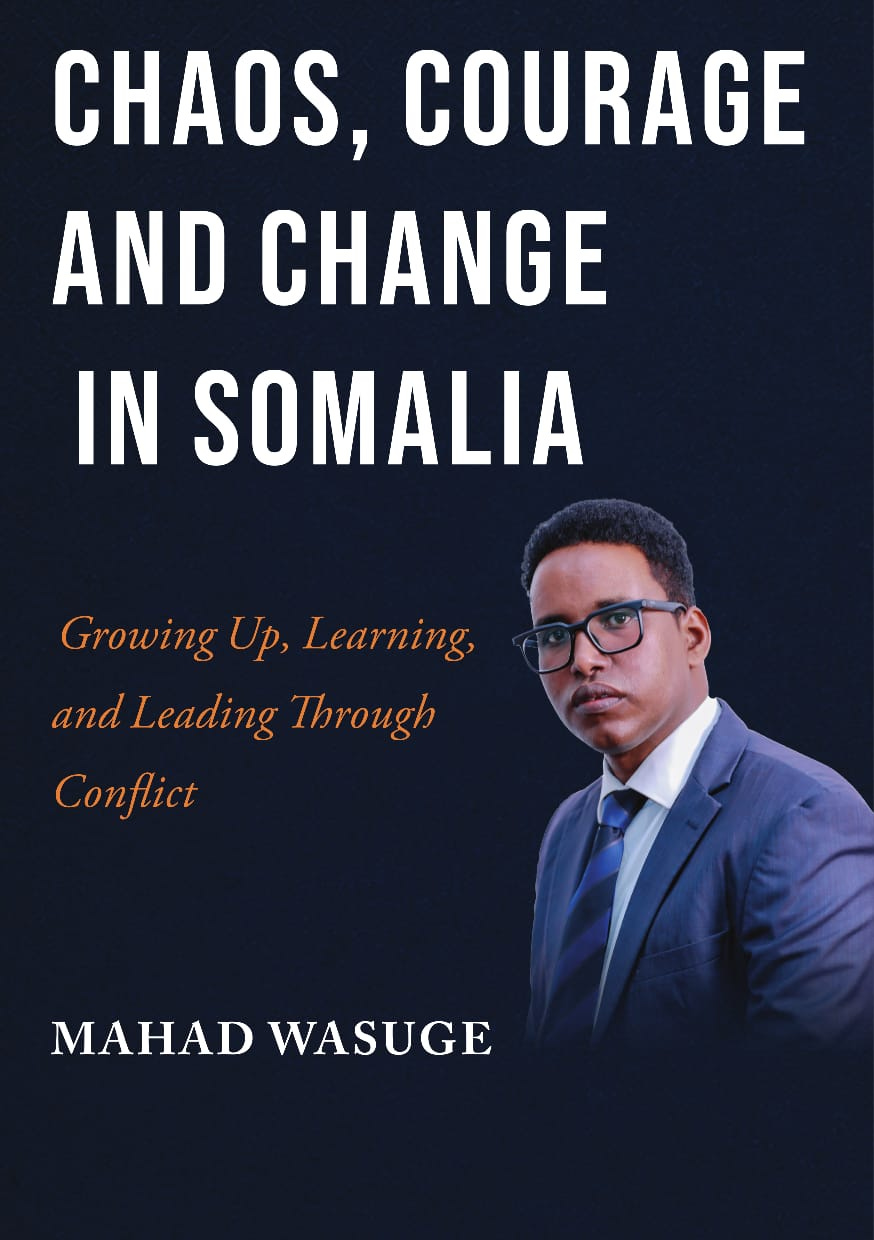
Chaos, Courage and Change in Somalia is more than an encounter with one man’s personal journey. It is an opportunity to reflect on how Somalia’s prolonged conflict has shaped an entire generation, disrupted educational opportunities, tested family resilience and influenced the aspirations of young people who grew up amid political instability. Through his experiences, Wasuge offers a valuable perspective on the relationship between personal perseverance, access to education and the gradual emergence of opportunities to contribute to public life. Wasuge’s childhood in Buulaburde, in the Hiiraan region, illustrates how insecurity penetrated ordinary life. Displacement, interrupted schooling, financial hardship and family responsibilities became inseparable from the experience of growing up. His account reminds readers that the costs of conflict cannot be measured solely by territory lost or lives taken, they must also be understood through the opportunities denied to children and the uncertainty imposed on families.
Wasuge’s pursuit of knowledge, from Qur’anic and Islamic studies to formal schooling and university education, demonstrates how learning can provide direction amid instability. Yet his journey also exposes the structural barriers facing Somali students, limited financial resources, insecurity, displacement and the absence of dependable institutions. His eventual admission to Mogadishu University represents an important achievement, but it also highlights a broader reality, for many young Somalis, education has required extraordinary persistence rather than benefiting from a stable and supportive system. family sacrifice, following the death of his father, Wasuge’s mother assumed the responsibility of sustaining the family while helping her children pursue their education. Her determination illustrates a dimension of Somalia’s resilience that often receives insufficient attention. Behind many of Somali success stories last three decades stands a mom whose sacrifices rarely receive sufficient recognition. Their labour, prayers and quiet endurance make possible achievements.
The book also raises important questions about the trajectories of young Somalis growing up amid conflict. In environments where educational opportunities, employment and institutional protection are limited, young people may find their ambitions frustrated or their lives redirected by insecurity and competing pressures. This wider context resonates with the experiences of many communities affected by the rise of armed movements and the prolonged absence of effective state institutions. The significance of Wasuge’s account lies in showing what persistence and access to opportunity can make possible, while reminding readers of the many young people whose circumstances have led them towards very different outcomes. His later professional experiences add another dimension to the memoir. Through journalism, research, and engagement with policy institutions. His reflections on professional recognition and institutional limitations are particularly relevant because they show that challenges do not necessarily end when an individual gains access to education or employment.
“One of my most painful memories takes me back to Buulaburde in 2006. One day, after the Dhuhr prayer, I encountered a former schoolmate who had once been among the brightest students in our school. He was someone I remembered for his intelligence and potential. During our conversation, he told me that he was serving al shabaab as the head of administration in Halgan, approximately 40 kilometres from Buulaburde, and was closely associated with Adan Hashi Ayrow’s circle.” His journey eventually brought him to Mogadishu on August 14, 2009, to pursue a university education. He arrived carrying his parents’ prayers and blessings, along with the emotional weight of saying goodbye to home. He had no established family support waiting for him in the capital. Instead, he carried hope, determination and the belief that education might open a door that years of hardship had kept closed. “Mogadishu in the late 2011 or early 2012, while walking home around Maghrib prayer time, near Benadir Junction, I witnessed a killing that remains painfully vivid in my memory. A man emerged from the direction of the road leading to Madina Hospital and ran towards another man who appeared unaware of his approach. He carried a pistol. Before the other man could react, he shot him in the chest and then fired several more bullets into his back.”
These memories are not identical to Wasuge’s experiences. They belong to different moments, different places and different personal journeys. Yet they meet in the same national tragedy: the struggle of young Somalis to preserve their humanity, education and aspirations amid prolonged instability. They also remind me of friends whose lives took different directions, including some who joined Al-Shabaab. What makes Wasuge’s memoir especially meaningful is that his story does not end with survival. Through education, journalism, research, professional experience and the establishment of Somali Public Agenda, he demonstrates how personal struggle can become a foundation for public contribution. His journey does not suggest that determination alone can overcome every obstacle. Rather, it shows the importance of perseverance, family sacrifice, timely opportunities and the willingness to create something useful from difficult experiences. Wasuge’s achievements deserve recognition. The book is most compelling when read not simply as an inspiring personal account but as an invitation to examine the conditions that enable or constrain human potential.
For me, of Chaos, Courage and Change in Somalia lies in its powerful connection between individual perseverance and collective responsibility. Mahad’s journey reminds us that personal achievement becomes even more meaningful when it creates opportunities for others. When I began reading this book 1st October, I had planned to share my reflection in November. I expected to read a few pages as part of my daily reading, take notes and return later to write my review. However, Wasuge’s chronological account, the richness of his experiences and the human stories woven throughout the chapters gradually changed that plan. I found myself reading beyond my intended daily pages and monthly plan, eager to discover what came next. Perhaps even more significantly, the book influenced a project much closer to my heart, the manuscript I am writing about my late sister, Colonel Fatima. As I followed Wasuge’s account of personal struggle, sacrifice, ambition and service, I began reconsidering how I was telling my sister’s story. I am grateful thanking to Ustaad Mahad Wasuge for sharing his story!